
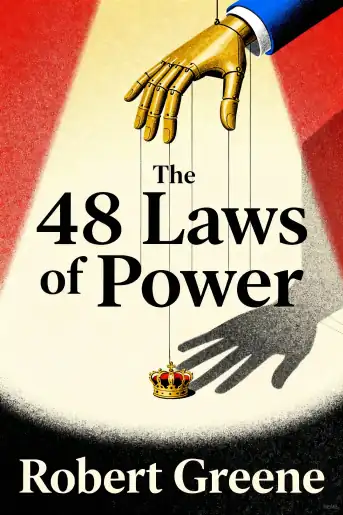
48 Laws of Power and the New Testament
Is being strategic actually a sin? Explore how Jesus used shrewd wisdom and selective silence to navigate a broken world without losing his holiness.

Best quote from 48 Laws of Power and the New Testament
Transparency without discernment is just naïveté. You can be 'innocent as a dove'—meaning your heart is pure and your motives are good—while still being 'shrewd' enough to know when to keep your mouth shut.

This audio lesson was created by a BeFreed community member
Explain the 48 laws of power and how they are tied in to the New Testament of the Holy Bible.


Frequently Asked Questions
While Robert Greene’s book is often viewed as cynical or "evil," the script argues that many of its strategic observations are actually present in the New Testament. Jesus commanded his followers to be "wise as serpents and innocent as doves," suggesting that holiness does not require gullibility. By examining Jesus' life, listeners can see how he used strategic tactics—such as selective silence and concealing intentions—not for selfish gain, but to protect his mission and navigate a broken, hostile world.
Jesus utilized "selective silence" and parables as a form of strategic ambiguity, similar to Law 4 ("Always Say Less Than Necessary") and Law 3 ("Conceal Your Intentions"). This was not about being deceptive, but about controlling the flow of information and managing the timing of his revelation. By speaking in parables, he provided truth to those truly seeking it while withholding leverage from hostile authorities who wanted to use his words against him.
Yes, the script highlights this through the example of John the Baptist, who famously stepped back to let Jesus take the lead, stating, "He must increase, but I must decrease." This demonstrated an understanding of institutional stability and the danger of triggered egos. Jesus also taught his disciples to avoid vying for the "top spot," reframing greatness as service. In this context, "never outshining" is about humility and ensuring the mission succeeds rather than competing for personal glory.
The primary difference lies in the "Decision Lens" or the ultimate purpose behind the action. Manipulation seeks self-aggrandizement or the coercion of others for selfish ends. In contrast, "holy shrewdness" uses strategic wisdom—like reading a room, mastering timing, or being adaptable—to protect the truth and serve others effectively. It is about being "untrapable" by the "wolves" of the world so that one can remain "unstoppable" in doing good.
The script suggests adopting "Realism over Romanticism." Jesus was a realist who "did not entrust himself to men because he knew what was in their hearts," anticipating betrayal even from his inner circle. For modern leaders, this means practicing "Information Hygiene" and not building the foundation of a mission solely on the fickle loyalty of others. By grounding authority in a higher purpose rather than public praise, a leader can remain focused even when faced with human failure.
Discover more

Master Machiavellianism & 48 Laws of Power
Master Machiavellianism & 48 Laws of Power
This plan distills centuries of political philosophy and psychological strategy into actionable professional skills. It is essential for leaders, negotiators, and ambitious professionals who need to navigate complex social hierarchies and protect themselves from manipulation.

Laws of power
Laws of power
This plan bridges the gap between historical statecraft and modern psychological influence, offering a blueprint for navigating competitive environments. It is essential for aspiring leaders and professionals who want to master the art of ethical persuasion and strategic decision-making.

Modern Work Politics: Machiavelli & 48 Laws
Modern Work Politics: Machiavelli & 48 Laws
In high-stakes corporate environments, technical skill alone rarely guarantees advancement. This plan is designed for ambitious professionals who need to master the unspoken rules of influence and power dynamics to secure their seat at the table.
Financial Independence & 48 Laws of Power
Financial Independence & 48 Laws of Power
This plan bridges the gap between wealth accumulation and the strategic influence required to protect and grow it. It is ideal for ambitious professionals and entrepreneurs who want to master both the mechanics of money and the psychology of power.
Strategic Power & Influence Curriculum
Strategic Power & Influence Curriculum
This curriculum is essential for leaders navigating complex corporate landscapes where formal authority isn't enough. It benefits executives and managers who need to master high-stakes negotiation and systemic change to drive impact.

Robert Greene: The Power & Human Nature Pod
Robert Greene: The Power & Human Nature Pod
This plan distills Robert Greene's essential wisdom on influence and social dynamics into actionable lessons. It is ideal for leaders, entrepreneurs, and anyone seeking to navigate human nature with greater strategic clarity and psychological insight.
DARK SYCHOLOGY AS DOMINEERANCE
DARK SYCHOLOGY AS DOMINEERANCE
In an era where influence is currency, understanding the mechanics of psychological subversion is essential for personal protection and strategic leadership. This plan is designed for professionals and individuals seeking to decode complex power dynamics and build a robust defense against manipulative personalities.

To manipulate others
To manipulate others
This plan is essential for leaders and professionals who need to navigate complex social hierarchies and master the art of persuasion. It provides a comprehensive toolkit for understanding human motivation and protecting oneself from covert influence.
From Columbia University alumni built in San Francisco
"Instead of endless scrolling, I just hit play on BeFreed. It saves me so much time."


"I never knew where to start with nonfiction—BeFreed’s book lists turned into podcasts gave me a clear path."


"Perfect balance between learning and entertainment. Finished ‘Thinking, Fast and Slow’ on my commute this week."
"Crazy how much I learned while walking the dog. BeFreed = small habits → big gains."
"Reading used to feel like a chore. Now it’s just part of my lifestyle."

"Feels effortless compared to reading. I’ve finished 6 books this month already."
"BeFreed turned my guilty doomscrolling into something that feels productive and inspiring."

"BeFreed turned my commute into learning time. 20-min podcasts are perfect for finishing books I never had time for."
"BeFreed replaced my podcast queue. Imagine Spotify for books — that’s it. 🙌"

"It is great for me to learn something from the book without reading it."
"The themed book list podcasts help me connect ideas across authors—like a guided audio journey."
"Makes me feel smarter every time before going to work"
From Columbia University alumni built in San Francisco
"Instead of endless scrolling, I just hit play on BeFreed. It saves me so much time."
"I never knew where to start with nonfiction—BeFreed’s book lists turned into podcasts gave me a clear path."
"Perfect balance between learning and entertainment. Finished ‘Thinking, Fast and Slow’ on my commute this week."
"Crazy how much I learned while walking the dog. BeFreed = small habits → big gains."
"Reading used to feel like a chore. Now it’s just part of my lifestyle."
"Feels effortless compared to reading. I’ve finished 6 books this month already."
"BeFreed turned my guilty doomscrolling into something that feels productive and inspiring."
"BeFreed turned my commute into learning time. 20-min podcasts are perfect for finishing books I never had time for."
"BeFreed replaced my podcast queue. Imagine Spotify for books — that’s it. 🙌"
"It is great for me to learn something from the book without reading it."
"The themed book list podcasts help me connect ideas across authors—like a guided audio journey."
"Makes me feel smarter every time before going to work"
"Instead of endless scrolling, I just hit play on BeFreed. It saves me so much time."
"I never knew where to start with nonfiction—BeFreed’s book lists turned into podcasts gave me a clear path."
"Perfect balance between learning and entertainment. Finished ‘Thinking, Fast and Slow’ on my commute this week."
"Crazy how much I learned while walking the dog. BeFreed = small habits → big gains."
"Reading used to feel like a chore. Now it’s just part of my lifestyle."
"Feels effortless compared to reading. I’ve finished 6 books this month already."
"BeFreed turned my guilty doomscrolling into something that feels productive and inspiring."
"BeFreed turned my commute into learning time. 20-min podcasts are perfect for finishing books I never had time for."
"BeFreed replaced my podcast queue. Imagine Spotify for books — that’s it. 🙌"
"It is great for me to learn something from the book without reading it."
"The themed book list podcasts help me connect ideas across authors—like a guided audio journey."
"Makes me feel smarter every time before going to work"
"Instead of endless scrolling, I just hit play on BeFreed. It saves me so much time."
"I never knew where to start with nonfiction—BeFreed’s book lists turned into podcasts gave me a clear path."
"Perfect balance between learning and entertainment. Finished ‘Thinking, Fast and Slow’ on my commute this week."
"Crazy how much I learned while walking the dog. BeFreed = small habits → big gains."
"Reading used to feel like a chore. Now it’s just part of my lifestyle."
"Feels effortless compared to reading. I’ve finished 6 books this month already."
"BeFreed turned my guilty doomscrolling into something that feels productive and inspiring."
"BeFreed turned my commute into learning time. 20-min podcasts are perfect for finishing books I never had time for."
"BeFreed replaced my podcast queue. Imagine Spotify for books — that’s it. 🙌"
"It is great for me to learn something from the book without reading it."
"The themed book list podcasts help me connect ideas across authors—like a guided audio journey."
"Makes me feel smarter every time before going to work"


