
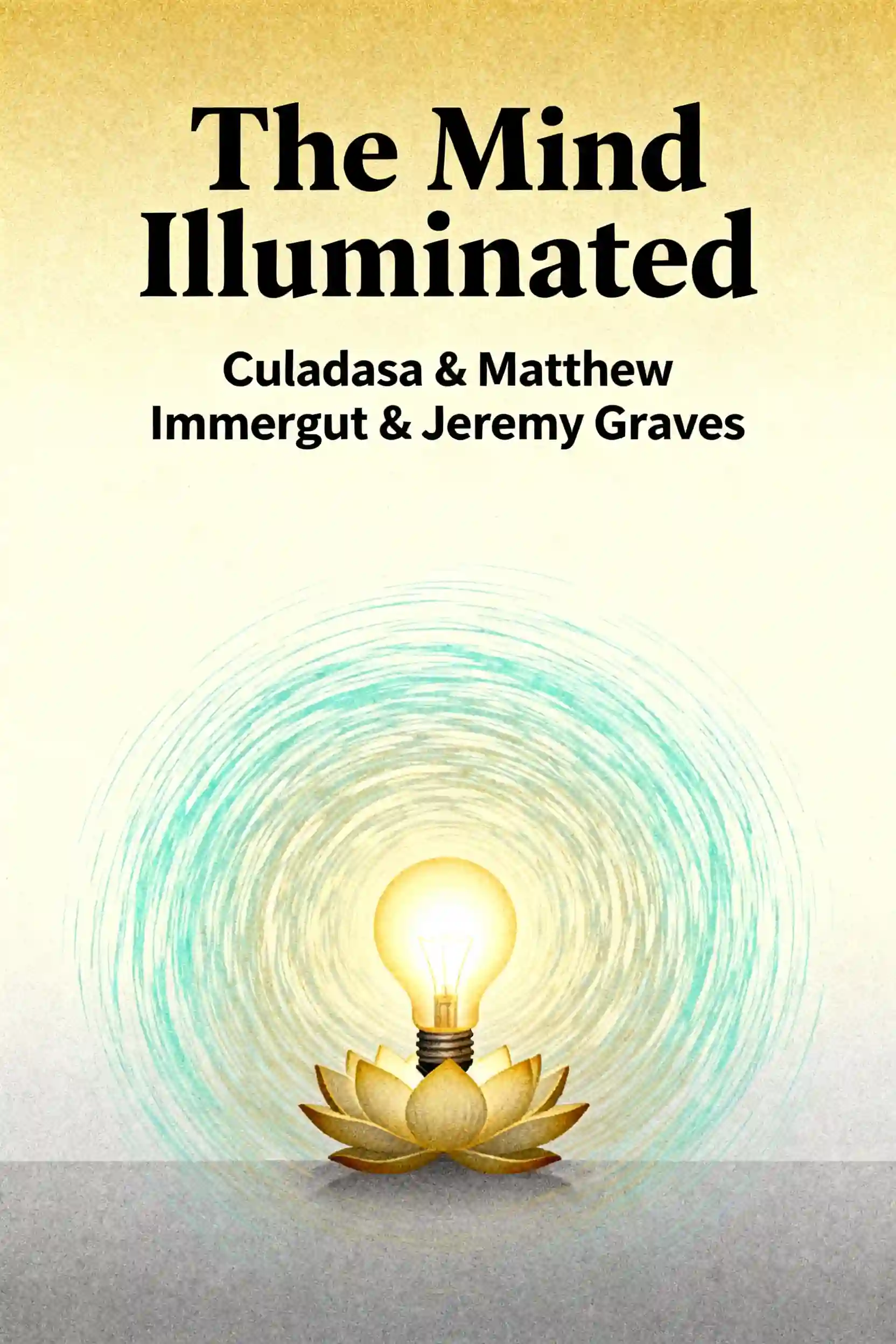
The Mind Illuminated: Ancient Wisdom Meets Neuroscience
Discover a systematic ten-stage map to master meditation by blending Buddhist mind science with modern neuroscience to rewire your brain and transcend the narrative self.

Best quote from The Mind Illuminated: Ancient Wisdom Meets Neuroscience
Meditation is not just about 'chilling out,' but a systematic map for the mind that allows us to move from a 'narrative self' stuck in stories to a 'minimal self' that is awake, aware, and deeply connected to the world.

This audio lesson was created by a BeFreed community member
I want to learn about mindfulness techniques. Specifically, I am interested in learning about meditation. I’d like to incorporate some Buddhist wisdom along with science backed techniques.

Frequently Asked Questions
Samatha is referred to as "focused attention" meditation, where the practitioner picks a single object, such as the breath, to develop attentional stability and absorption. This practice is associated with increased frontal midline theta activity in the brain, which helps quiet "discursive thought" or inner chatter. In contrast, Vipassana is "open monitoring" or insight meditation. Instead of focusing on one object, the practitioner observes the entire flow of thoughts, sensations, and emotions as a witness without labeling them. This practice is linked to enhanced perceptual clarity and a reduction in the "narrative ego."
The Default Mode Network (DMN) is the brain's "auto-pilot" system that becomes active when the mind is wandering, daydreaming, or ruminating on the past and future. While necessary for creativity, an overactive DMN is linked to chronic stress and depression. Meditation acts as a recalibration tool for this network by increasing connectivity between the DMN and the "salience network," which decides what is important in the present moment. Long-term practice can lead to structural changes, such as increased gray matter density in the hippocampus and a decrease in the volume of the amygdala, the brain's fear center.
Dependent Arising is the principle that nothing exists in isolation; everything is a collection of parts and causes, like a cup made of clay, water, and heat. Applying this to the "self" means recognizing that the "I" is not a fixed, solid entity but a shifting collection of cells, memories, and thoughts. Emptiness is the realization that things lack a fixed, inherent identity and that humans provide the labels. Understanding these concepts helps "decouple" the sense of self from stressful experiences, reducing attachment to rigid narratives like "I am a failure" and fostering a sense of interconnectedness with others.
Metta is the practice of cultivating unconditional goodwill toward oneself and others. While it feels like an emotion, research shows it creates a functional shift in how the brain processes information. EEG studies indicate that Metta reduces the "self-other P300 amplitude differences," meaning the brain begins to balance how it processes "me" versus "you." Unlike simple empathy, which can lead to burnout by absorbing others' pain, Metta focuses on the desire to alleviate suffering, which activates brain networks linked to reward and maternal love, ultimately protecting the practitioner's mental health.
"McMindfulness" is a critique of modern, secular mindfulness that strips away ethical and philosophical roots to focus solely on stress reduction or productivity. Scholars argue that without the foundation of "Sīla" (ethical conduct) and "Bodhicitta" (the aspiration to benefit all beings), meditation becomes just another tool rather than a transformative practice. Integrating ethics allows practitioners to use mindfulness as a "monitor" for their actions and speech in real-time, moving beyond symptom management toward "flourishing" and a proactive transformation of character.
Discover more

Study Mind, Brain, Philosophy & Mindfulness
Study Mind, Brain, Philosophy & Mindfulness
This plan bridges the gap between empirical neuroscience and ancient wisdom, offering a holistic approach to understanding human consciousness. It is ideal for curious learners, mental health advocates, or professionals seeking to integrate mindfulness with a rigorous scientific and philosophical foundation.

Mastering Consciousness & Identity Shift
Mastering Consciousness & Identity Shift
This plan bridges the gap between ancient mindfulness and modern neuroscience for those seeking profound personal evolution. It is ideal for individuals ready to move beyond surface-level habits to fundamentally rewire their sense of self.

Mindfulness, Psychology & Philosophy Study
Mindfulness, Psychology & Philosophy Study
This plan bridges the gap between ancient contemplative wisdom and modern scientific understanding. It is ideal for seekers, students of psychology, or anyone looking to deepen their meditation practice through a rigorous philosophical and neurological lens.
To meditate
To meditate
This comprehensive plan bridges the gap between scientific understanding and ancient contemplative wisdom. It is ideal for anyone seeking to move beyond basic relaxation toward a profound, integrated mastery of their mental and emotional landscape.

Self-Improvement, Mindfulness & Neuroscience
Self-Improvement, Mindfulness & Neuroscience
This plan bridges the gap between ancient mindfulness practices and modern neuroscience to provide a data-driven approach to personal growth. It is ideal for high-performers and lifelong learners seeking to master their habits and mental state through a deeper understanding of brain function.
Master Self, Mind, Science & Human Connection
Master Self, Mind, Science & Human Connection
In an era of digital distraction, understanding the intersection of neuroscience and self-awareness is vital for personal growth. This plan is designed for individuals seeking to bridge the gap between scientific knowledge and emotional mastery to enhance their relationships and mental well-being.
Explore my mind and its capabilities
Explore my mind and its capabilities
This plan bridges the gap between biological neuroscience and practical mental mastery. It is designed for lifelong learners and professionals seeking to optimize their cognitive performance and deepen their self-understanding through science-backed methods.
Mind is master
Mind is master
This plan is essential for high-performers and lifelong learners seeking to move beyond surface-level productivity into deep cognitive mastery. It provides a bridge between rigorous neuroscience and advanced consciousness practices for anyone wanting to reclaim control over their mental reality.
From Columbia University alumni built in San Francisco
"Instead of endless scrolling, I just hit play on BeFreed. It saves me so much time."


"I never knew where to start with nonfiction—BeFreed’s book lists turned into podcasts gave me a clear path."


"Perfect balance between learning and entertainment. Finished ‘Thinking, Fast and Slow’ on my commute this week."
"Crazy how much I learned while walking the dog. BeFreed = small habits → big gains."
"Reading used to feel like a chore. Now it’s just part of my lifestyle."

"Feels effortless compared to reading. I’ve finished 6 books this month already."
"BeFreed turned my guilty doomscrolling into something that feels productive and inspiring."

"BeFreed turned my commute into learning time. 20-min podcasts are perfect for finishing books I never had time for."
"BeFreed replaced my podcast queue. Imagine Spotify for books — that’s it. 🙌"

"It is great for me to learn something from the book without reading it."
"The themed book list podcasts help me connect ideas across authors—like a guided audio journey."
"Makes me feel smarter every time before going to work"
From Columbia University alumni built in San Francisco
"Instead of endless scrolling, I just hit play on BeFreed. It saves me so much time."
"I never knew where to start with nonfiction—BeFreed’s book lists turned into podcasts gave me a clear path."
"Perfect balance between learning and entertainment. Finished ‘Thinking, Fast and Slow’ on my commute this week."
"Crazy how much I learned while walking the dog. BeFreed = small habits → big gains."
"Reading used to feel like a chore. Now it’s just part of my lifestyle."
"Feels effortless compared to reading. I’ve finished 6 books this month already."
"BeFreed turned my guilty doomscrolling into something that feels productive and inspiring."
"BeFreed turned my commute into learning time. 20-min podcasts are perfect for finishing books I never had time for."
"BeFreed replaced my podcast queue. Imagine Spotify for books — that’s it. 🙌"
"It is great for me to learn something from the book without reading it."
"The themed book list podcasts help me connect ideas across authors—like a guided audio journey."
"Makes me feel smarter every time before going to work"
"Instead of endless scrolling, I just hit play on BeFreed. It saves me so much time."
"I never knew where to start with nonfiction—BeFreed’s book lists turned into podcasts gave me a clear path."
"Perfect balance between learning and entertainment. Finished ‘Thinking, Fast and Slow’ on my commute this week."
"Crazy how much I learned while walking the dog. BeFreed = small habits → big gains."
"Reading used to feel like a chore. Now it’s just part of my lifestyle."
"Feels effortless compared to reading. I’ve finished 6 books this month already."
"BeFreed turned my guilty doomscrolling into something that feels productive and inspiring."
"BeFreed turned my commute into learning time. 20-min podcasts are perfect for finishing books I never had time for."
"BeFreed replaced my podcast queue. Imagine Spotify for books — that’s it. 🙌"
"It is great for me to learn something from the book without reading it."
"The themed book list podcasts help me connect ideas across authors—like a guided audio journey."
"Makes me feel smarter every time before going to work"
"Instead of endless scrolling, I just hit play on BeFreed. It saves me so much time."
"I never knew where to start with nonfiction—BeFreed’s book lists turned into podcasts gave me a clear path."
"Perfect balance between learning and entertainment. Finished ‘Thinking, Fast and Slow’ on my commute this week."
"Crazy how much I learned while walking the dog. BeFreed = small habits → big gains."
"Reading used to feel like a chore. Now it’s just part of my lifestyle."
"Feels effortless compared to reading. I’ve finished 6 books this month already."
"BeFreed turned my guilty doomscrolling into something that feels productive and inspiring."
"BeFreed turned my commute into learning time. 20-min podcasts are perfect for finishing books I never had time for."
"BeFreed replaced my podcast queue. Imagine Spotify for books — that’s it. 🙌"
"It is great for me to learn something from the book without reading it."
"The themed book list podcasts help me connect ideas across authors—like a guided audio journey."
"Makes me feel smarter every time before going to work"


