
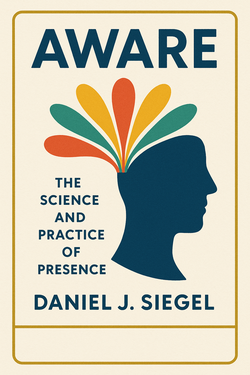
Daniel Siegel’s Aware: Rewiring Your Brain for Focus
Feeling scattered and reactive? Discover how the Wheel of Awareness helps you focus your attention to grow a healthier brain and find lasting calm.

Best quote from Daniel Siegel’s Aware: Rewiring Your Brain for Focus
Where attention goes, neural firing flows, and neural connection grows. It’s the idea that we can actually grow a healthier brain by changing how we focus.

This audio lesson was created by a BeFreed community member
Aware by Daniel j siegel

Frequently Asked Questions
The Wheel of Awareness is a visual metaphor created by Dr. Daniel Siegel to represent the architecture of human consciousness. It consists of a hub, which represents the act of "knowing" or pure awareness, and a rim, which contains everything that can be "known," such as sensory input, bodily sensations, and mental thoughts. By using a "spoke" of attention, an individual can intentionally direct their focus from the calm center of the hub to various points on the rim, allowing them to observe their experiences without becoming overwhelmed by them.
This concept is rooted in neuroplasticity, suggesting that we can physically rewire our brains by changing how we focus. When we intentionally direct our attention, we stimulate specific neural pathways; over time, repeated focus strengthens these connections, a process Dr. Siegel calls "growing a healthier brain." This practice can lead to physiological benefits such as reduced cortisol levels, enhanced immune function, and improved cardiovascular health by moving the mind from states of chaos or rigidity toward integration.
The practice categorizes the "knowns" on the rim into four segments encompassing eight senses. The first segment includes the five conventional senses: sight, hearing, smell, taste, and touch. The second segment is the "sixth sense" of interoception, which involves monitoring internal bodily signals like heart rate and muscle tension. The third segment is the "seventh sense," or the internal world of the mind, including thoughts, emotions, and memories. Finally, the "eighth sense" is interconnectedness, which focuses on our relationships with others and the wider world.
Dr. Siegel uses these scientific metaphors to distinguish between different states of mind. The rim of the wheel is the "Peak of Certainty," where thoughts, feelings, and sensations are specific, defined, and often reactive. In contrast, the hub is the "Plane of Possibility," a state of open awareness and pure potential. By resting in the hub, individuals can access a deep sense of calm and creativity, allowing them to choose how to respond to the "waves" of experience on the rim rather than being swept away by them.
The Wheel of Awareness is highly flexible and can be adapted into a "mini" version that takes as little as five to nine minutes. A simple daily "neural tune-up" involves a quick check-in to identify your current emotional drive, followed by moving the spoke of attention through the four segments of the rim—outer senses, inner body, mental activity, and connection. The practice emphasizes "mental reps," where the goal is not to maintain perfect focus but to kindly and repeatedly return the attention to the hub whenever the mind wanders.
Discover more

Improve focus and attention
Improve focus and attention
In an era of constant digital distraction, the ability to control your attention is a competitive advantage. This plan is ideal for professionals and students looking to master deep work, leverage neuroscience, and build sustainable peak performance habits.

Dopamine & Focus: Reclaim Your Attention
Dopamine & Focus: Reclaim Your Attention
In an era of constant digital stimulation, understanding the neurochemistry of motivation is essential for professional and personal success. This plan is ideal for knowledge workers and students looking to overcome distraction and master the art of deep, cognitively demanding work.
Strengthen my focus and mindset
Strengthen my focus and mindset
In an era of constant digital distraction, the ability to direct your attention is a competitive advantage. This plan is designed for professionals and students who want to combine mindfulness with high-performance science to achieve deep focus and mental resilience.

Sharpen Focus & Strengthen Willpower
Sharpen Focus & Strengthen Willpower
In an age of constant digital distraction, the ability to direct your attention is a superpower. This plan is designed for professionals and students who want to move beyond brute-force discipline and build a scientific foundation for lasting focus.
Rewire Mind: Build Habits & Positivity
Rewire Mind: Build Habits & Positivity
In an era of constant stress and distraction, understanding the biological mechanics of change is essential for personal growth. This plan is designed for individuals seeking to replace negative patterns with evidence-based habits and emotional resilience through the lens of neuroscience.

Live Mindfully & Happily
Live Mindfully & Happily
In an era of constant distraction, mastering your internal landscape is essential for mental health. This plan is designed for anyone feeling overwhelmed or disconnected who seeks to build a sustainable foundation of emotional intelligence and present-moment awareness.

Overcome maladaptive daydreaming for focus
Overcome maladaptive daydreaming for focus
This learning plan is designed for individuals struggling with maladaptive daydreaming, chronic zoning out, or attention control issues who want science-based solutions rather than anecdotal advice. It combines neuroscience, clinical psychology, and evidence-based interventions to provide data-driven strategies for improving focus and managing attention disorders. Ideal for learners who prefer rigorous, research-backed content over generalized self-help approaches.
Self-Improvement, Mindfulness & Tech Science
Self-Improvement, Mindfulness & Tech Science
In an era of constant digital distraction, mastering the intersection of neuroscience and mindfulness is essential for peak performance. This plan is designed for professionals and lifelong learners seeking to reclaim their focus and build resilient habits through scientific and meditative practices.
From Columbia University alumni built in San Francisco
"Instead of endless scrolling, I just hit play on BeFreed. It saves me so much time."


"I never knew where to start with nonfiction—BeFreed’s book lists turned into podcasts gave me a clear path."


"Perfect balance between learning and entertainment. Finished ‘Thinking, Fast and Slow’ on my commute this week."
"Crazy how much I learned while walking the dog. BeFreed = small habits → big gains."
"Reading used to feel like a chore. Now it’s just part of my lifestyle."

"Feels effortless compared to reading. I’ve finished 6 books this month already."
"BeFreed turned my guilty doomscrolling into something that feels productive and inspiring."

"BeFreed turned my commute into learning time. 20-min podcasts are perfect for finishing books I never had time for."
"BeFreed replaced my podcast queue. Imagine Spotify for books — that’s it. 🙌"

"It is great for me to learn something from the book without reading it."
"The themed book list podcasts help me connect ideas across authors—like a guided audio journey."
"Makes me feel smarter every time before going to work"
From Columbia University alumni built in San Francisco
"Instead of endless scrolling, I just hit play on BeFreed. It saves me so much time."
"I never knew where to start with nonfiction—BeFreed’s book lists turned into podcasts gave me a clear path."
"Perfect balance between learning and entertainment. Finished ‘Thinking, Fast and Slow’ on my commute this week."
"Crazy how much I learned while walking the dog. BeFreed = small habits → big gains."
"Reading used to feel like a chore. Now it’s just part of my lifestyle."
"Feels effortless compared to reading. I’ve finished 6 books this month already."
"BeFreed turned my guilty doomscrolling into something that feels productive and inspiring."
"BeFreed turned my commute into learning time. 20-min podcasts are perfect for finishing books I never had time for."
"BeFreed replaced my podcast queue. Imagine Spotify for books — that’s it. 🙌"
"It is great for me to learn something from the book without reading it."
"The themed book list podcasts help me connect ideas across authors—like a guided audio journey."
"Makes me feel smarter every time before going to work"
"Instead of endless scrolling, I just hit play on BeFreed. It saves me so much time."
"I never knew where to start with nonfiction—BeFreed’s book lists turned into podcasts gave me a clear path."
"Perfect balance between learning and entertainment. Finished ‘Thinking, Fast and Slow’ on my commute this week."
"Crazy how much I learned while walking the dog. BeFreed = small habits → big gains."
"Reading used to feel like a chore. Now it’s just part of my lifestyle."
"Feels effortless compared to reading. I’ve finished 6 books this month already."
"BeFreed turned my guilty doomscrolling into something that feels productive and inspiring."
"BeFreed turned my commute into learning time. 20-min podcasts are perfect for finishing books I never had time for."
"BeFreed replaced my podcast queue. Imagine Spotify for books — that’s it. 🙌"
"It is great for me to learn something from the book without reading it."
"The themed book list podcasts help me connect ideas across authors—like a guided audio journey."
"Makes me feel smarter every time before going to work"
"Instead of endless scrolling, I just hit play on BeFreed. It saves me so much time."
"I never knew where to start with nonfiction—BeFreed’s book lists turned into podcasts gave me a clear path."
"Perfect balance between learning and entertainment. Finished ‘Thinking, Fast and Slow’ on my commute this week."
"Crazy how much I learned while walking the dog. BeFreed = small habits → big gains."
"Reading used to feel like a chore. Now it’s just part of my lifestyle."
"Feels effortless compared to reading. I’ve finished 6 books this month already."
"BeFreed turned my guilty doomscrolling into something that feels productive and inspiring."
"BeFreed turned my commute into learning time. 20-min podcasts are perfect for finishing books I never had time for."
"BeFreed replaced my podcast queue. Imagine Spotify for books — that’s it. 🙌"
"It is great for me to learn something from the book without reading it."
"The themed book list podcasts help me connect ideas across authors—like a guided audio journey."
"Makes me feel smarter every time before going to work"


