
Book
Ultralearning
Scott H. Young
Master hard skills quickly, future-proof your career through self-education and intense learning strategies.

00:00
00:00
Looking for a Coursera alternative? Compare 9 top platforms with pricing, pros, and cons to find your best fit in 2026.

The best Coursera alternatives in 2026 are BeFreed, edX, LinkedIn Learning, Skillshare, Khan Academy, MasterClass, Udacity, Pluralsight, and FutureLearn. Each platform offers a different approach to online learning — from AI-powered microlearning to university-backed certificates — so the right choice depends on your goals, budget, and preferred learning style.
With the Coursera-Udemy merger announced in December 2025 (expected to close in the second half of 2026), the online education landscape is shifting fast. Many learners are reconsidering their options. If you want a flexible, AI-driven way to learn from the world's best books without sitting through long video lectures, BeFreed gives you personalized audio summaries of 50,000+ titles — perfect for busy professionals who value their time.
Not every Coursera alternative serves the same purpose. Here's a quick decision guide based on what you actually want to achieve:
If your goal is earning recognized credentials → go with edX or LinkedIn Learning. Both offer certificates that carry weight with employers, and edX partners with top universities for MicroMasters programs.
If your goal is learning for free → start with Khan Academy. It covers math, science, computing, and economics at no cost, with no hidden paywalls.
If your goal is absorbing knowledge fast from books → try BeFreed. Its AI podcast generator turns 50,000+ book summaries into personalized audio you can listen to anywhere.
If your goal is building creative skills → Skillshare is your best bet. It specializes in design, illustration, photography, writing, and other creative disciplines.
If your goal is tech career specialization → choose Udacity for structured nanodegree programs or Pluralsight for IT skills assessments and role-based learning paths.
If your goal is personal enrichment from famous experts → MasterClass delivers cinematic lessons from people like Gordon Ramsay, Neil deGrasse Tyson, and Serena Williams.
The biggest reason people are searching for Coursera alternatives right now is the Coursera-Udemy merger. Announced in December 2025 as a $2.5 billion all-stock deal, this merger combines Coursera's university partnerships with Udemy's massive instructor marketplace. While the companies say it will "empower the global workforce," many learners are concerned about what consolidation means for pricing and course diversity.
Beyond the merger, several other factors are driving people away from Coursera:
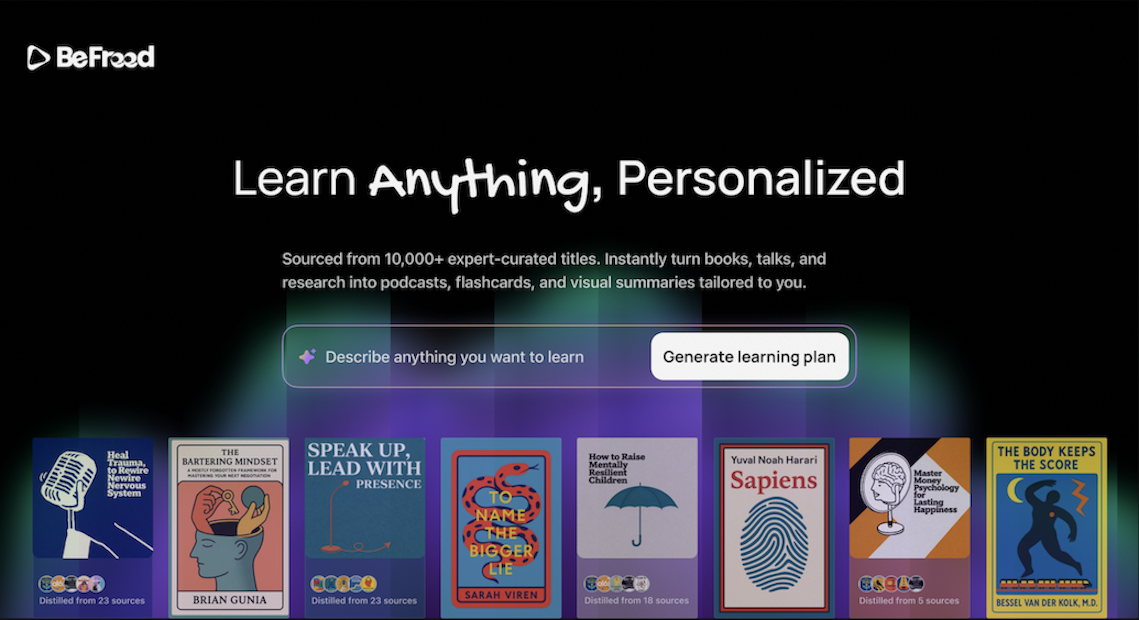
BeFreed takes a fundamentally different approach to online learning. Instead of video lectures and quizzes, it uses AI to turn 50,000+ book summaries into personalized podcast episodes tailored to your interests and learning style. You choose your depth — 10, 20, or 40-minute episodes — and the AI adapts the content to what matters most to you.
The platform also offers adaptive learning plans that build a structured path through topics based on your goals. Want to understand behavioral economics? BeFreed will map out the key books, generate audio summaries, and track your progress. It's like having a personal reading coach that fits into your commute or workout.
Why It Stands Out: BeFreed is the only platform that combines AI-generated podcasts with book-based knowledge, making it perfect for learners who want to absorb ideas quickly without watching hours of video content.
Pricing: Free tier available. Premium plans offer unlimited access to all book summaries and AI podcast features.
My Take: If you're the kind of person who buys books but never finishes them, BeFreed is a genuine solution. I find it most useful for professional development topics — leadership, psychology, business strategy — where you want the core ideas without the 300-page commitment. Reddit users in career-focused subs frequently mention wanting "the key takeaways without the fluff," and that's exactly what BeFreed delivers. It won't replace a full Coursera certificate program, but for continuous learning and staying sharp, it's unmatched.
For example, Scott H. Young's Ultralearning teaches you how to master hard skills quickly through self-directed learning — and BeFreed turns its key insights into a personalized podcast you can absorb during your commute.
Master hard skills quickly, future-proof your career through self-education and intense learning strategies.
For a deeper audio dive into how AI is changing self-education, listen to Cross-Domain Learning Revolution with BeFreed — it explores how personalized learning breaks traditional educational barriers.


Discover how AI-powered personalized learning breaks traditional educational barriers, enabling you to explore connections across multiple knowledge domains-from neuroscience to business-through engaging, adaptive content that matches your curiosity and learning style.
edX is the closest direct alternative to Coursera's academic model. Founded by Harvard and MIT, it offers courses from 160+ universities and institutions worldwide. You can audit most courses for free, and verified certificates start at around $50 — significantly cheaper than Coursera's per-specialization pricing.
What sets edX apart is its MicroMasters programs, which cost $600-1,500 and can count as credit toward a full master's degree at participating universities. This is a genuine pathway to a graduate degree at a fraction of the cost.
Why It Stands Out: University partnerships with Harvard, MIT, Berkeley, and more give edX certificates real academic weight. The free audit option means you can learn without paying anything upfront.
Pricing: Free to audit most courses. Verified certificates from $50. MicroMasters programs $600-1,500. Full online degrees available.
My Take: edX is my top recommendation if you need a credential that employers and graduate schools actually recognize. The free audit option is generous — you get full access to course materials, just without the certificate. The downside is that edX courses can feel as rigorous and time-consuming as actual college classes, which isn't ideal if you just want to pick up a skill quickly. Reddit users praise the Harvard CS50 course as one of the best free learning resources on the internet, and I agree.
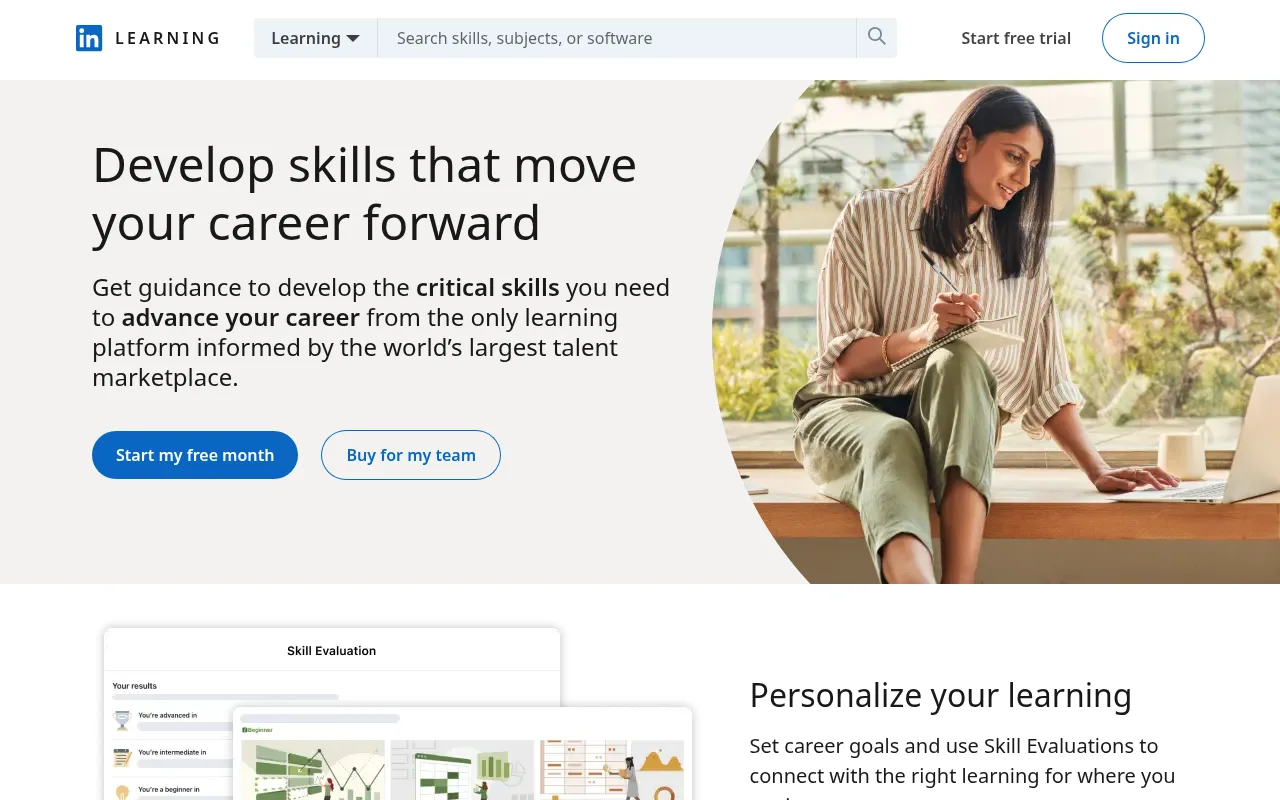
LinkedIn Learning (formerly Lynda.com) offers 21,000+ courses focused on business, technology, and creative skills. Its killer feature is integration with your LinkedIn profile — completed courses and certificates show up directly on your profile where recruiters can see them.
The platform uses AI to recommend courses based on your job title, skills gaps, and career goals. It's particularly strong for soft skills, management training, and professional tools like Excel, Salesforce, and project management software.
Why It Stands Out: Direct LinkedIn profile integration means your learning efforts are visible to recruiters and hiring managers. Course recommendations are personalized to your career trajectory.
Pricing: $39.99/month or $239.88/year (billed annually). Free 1-month trial available. Many public libraries offer free access.
My Take: LinkedIn Learning is the pragmatic choice for working professionals. The courses are shorter than Coursera's (most are 1-3 hours), which makes them easier to fit into a busy schedule. The LinkedIn profile integration is genuinely useful for job seekers. The weakness is depth — if you need a rigorous, semester-length deep dive into machine learning, this isn't the place. But for "I need to learn Tableau by Friday," it's perfect. Pro tip from Reddit: check if your local library offers free LinkedIn Learning access before paying.
Skillshare fills a gap that Coursera barely touches: creative education. With 30,000+ classes in illustration, graphic design, photography, writing, animation, and more, it's the go-to platform for anyone looking to develop creative and artistic skills.
Classes are project-based, meaning you create something tangible as you learn. The community aspect is strong too — you can share projects, get feedback from other students, and follow your favorite instructors.
Why It Stands Out: Project-based creative learning with a strong community. No other major platform covers creative skills with this much depth and variety.
Pricing: $13.99/month billed annually ($167.88/year). Free 7-day trial. Individual classes can be more expensive on a month-to-month basis.
My Take: If you're looking for a Coursera alternative specifically for creative or artistic learning, Skillshare is the clear winner. Coursera has almost nothing in this space. The project-based format forces you to actually practice, not just passively watch videos. The trade-off is that Skillshare has no certificates with employer recognition — it's purely about skill building. Reddit users in creative subs generally rate Skillshare positively for illustration and design, but note that instructor quality varies widely since anyone can teach on the platform.
Khan Academy is the gold standard for free online education. Founded as a nonprofit, it offers completely free courses in math, science, computing, economics, arts, and humanities. There are no premium tiers, no paywalls, and no certificates to upsell — everything is free, forever.
The platform is especially strong for foundational subjects. Its math courses use adaptive practice exercises that adjust difficulty based on your performance, and the bite-sized lesson format (5-15 minute videos) makes it easy to learn in short sessions.
Why It Stands Out: 100% free, nonprofit model. Adaptive practice exercises for math and science. Strong K-12 through early college coverage with no hidden costs.
Pricing: Completely free. No premium tier. Funded by donations and grants.
My Take: Khan Academy is unbeatable if you need to build or refresh foundational knowledge without spending a cent. It's the best math resource on the internet, period. The limitation is scope — it doesn't cover professional skills, programming beyond basics, or creative subjects with the depth of paid platforms. For career-focused learners, think of Khan Academy as a complement to other platforms, not a replacement. Reddit users consistently recommend it for anyone "relearning math from scratch" before tackling data science on other platforms.
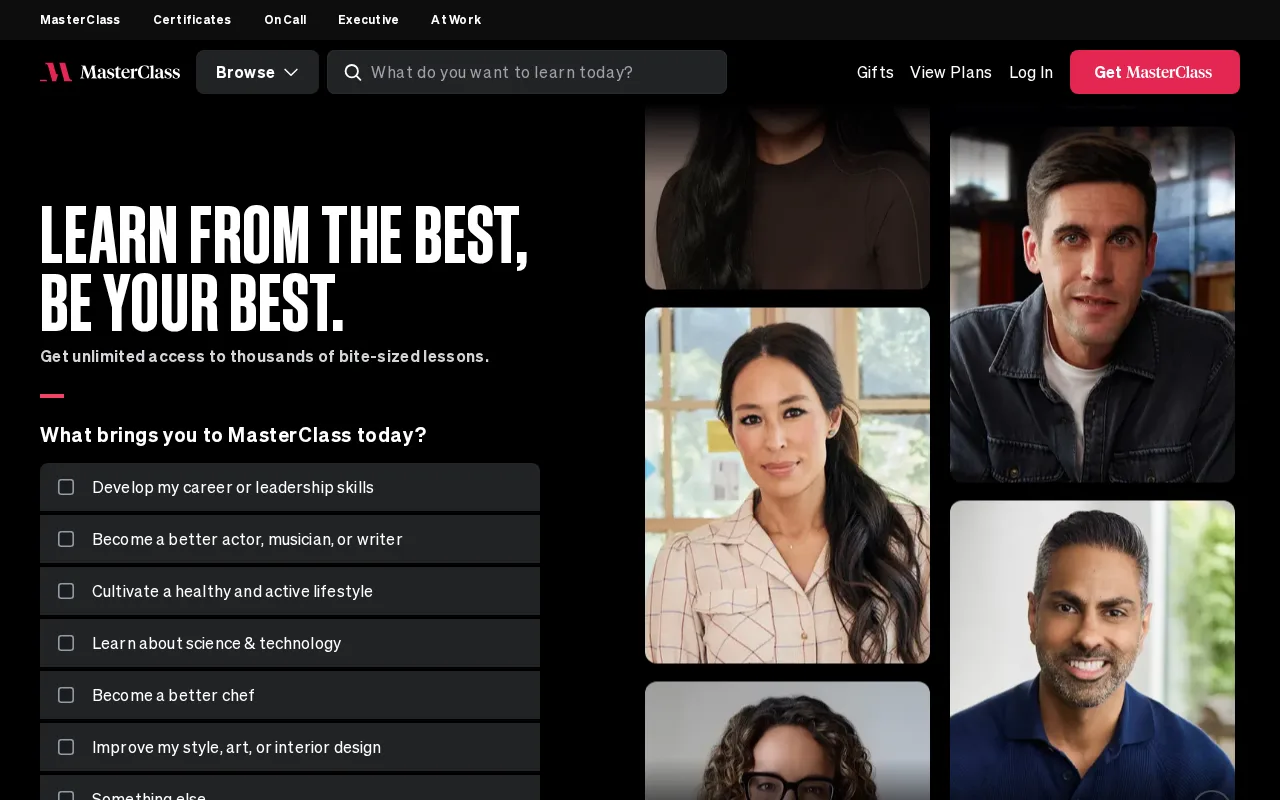
MasterClass is unlike any other platform on this list. Its courses are taught by world-famous experts — Gordon Ramsay on cooking, Martin Scorsese on filmmaking, Neil deGrasse Tyson on scientific thinking, Serena Williams on tennis. The production quality rivals Netflix documentaries.
This is not a platform for career credentials or technical skill-building. It's for personal enrichment and inspiration. Each class includes about 20 video lessons (10-15 minutes each), a downloadable workbook, and community discussion.
Why It Stands Out: Cinematic production quality with celebrity instructors. No other platform offers this caliber of teaching talent in such an engaging format.
Pricing: Individual plan $10/month billed annually ($120/year). Duo plan $15/month. Family plan $20/month. 30-day money-back guarantee.
My Take: MasterClass is excellent entertainment that also teaches you something. I wouldn't recommend it as a primary learning platform, but as a supplement to more structured education, it's genuinely inspiring. The cooking, writing, and music classes are standouts. Reddit sentiment is mixed — people love the production quality but question whether you actually learn practical skills. My honest take: you'll come away inspired and with some useful frameworks, but you won't be job-ready in any subject after watching a MasterClass.
Udacity specializes in technology and digital skills through its signature "Nanodegree" programs. These are 3-6 month intensive programs developed in partnership with companies like Google, Amazon, and NVIDIA, focusing on AI, data science, cloud computing, programming, and autonomous systems.
Each nanodegree includes real-world projects reviewed by industry professionals, mentorship access, and career services. The curriculum is designed to make you job-ready in a specific tech role.
Why It Stands Out: Industry-developed nanodegrees with project reviews from professionals. Strong focus on emerging tech fields like AI, machine learning, and cloud architecture.
Pricing: Nanodegrees typically cost $249-399/month, with most programs taking 3-4 months. Some free courses available. Occasional promotional pricing.
My Take: Udacity is the most career-focused option on this list for tech professionals. The nanodegrees are intensive and expensive, but they come with portfolio-ready projects and career coaching that Coursera doesn't match. The downside is the narrow focus — if you want anything outside of tech, look elsewhere. Reddit users in programming subs report that Udacity nanodegrees helped them land jobs, but also note that the same material is available for free on YouTube if you're disciplined enough to learn independently.
Pluralsight is a skills development platform built for technology professionals and teams. It offers 7,000+ courses in software development, IT operations, cybersecurity, data, and cloud computing, plus unique features like skill assessments and role-based learning paths.
The Skill IQ assessment tests your current proficiency and identifies gaps, while Role IQ maps out what you need to learn for specific job titles. This data-driven approach makes Pluralsight popular with enterprise teams and individual IT professionals tracking their career growth.
Why It Stands Out: Skill IQ assessments and role-based learning paths create a structured progression. Strong enterprise features for team management and skills tracking.
Pricing: Standard plan $29/month or $299/year. Premium plan $45/month or $449/year (includes projects, exams, and certification practice). Free 10-day trial.
My Take: Pluralsight is the best option for working IT professionals who need to keep their skills current. The Skill IQ feature is genuinely useful for identifying what you don't know. It's less suitable for beginners or anyone outside the tech industry. Reddit users in sysadmin and DevOps communities rate Pluralsight highly for Azure, AWS, and Kubernetes content, but note that the video quality varies between older and newer courses.
FutureLearn is a UK-based platform offering courses from 250+ international universities and organizations, including the British Museum, King's College London, and UNESCO. It's particularly strong for social sciences, healthcare, education, and humanities — areas where Coursera's US-centric catalog can feel limited.
The platform's social learning approach encourages discussion between students on every lesson, creating a more collaborative experience. Courses follow a flexible weekly structure, and many offer free access for the duration of the course.
Why It Stands Out: International perspective with strong UK and European university partnerships. Social learning features built into every course. Good coverage of humanities and social sciences.
Pricing: Free access to many courses (time-limited). Unlimited subscription $249.99/year. Individual course upgrades from $39-89. Full degrees available.
My Take: FutureLearn is an underrated Coursera alternative, especially if you want a global perspective beyond the US university system. The social learning features make it feel less lonely than solo video-watching on other platforms. The weakness is that its tech and business course catalog is thinner than Coursera's or edX's. Reddit mentions of FutureLearn are less frequent than other platforms, but users who've tried it appreciate the course quality from UK universities.
| Feature | BeFreed | edX | LinkedIn Learning | Skillshare | Khan Academy | MasterClass | Udacity | Pluralsight | FutureLearn |
|---|---|---|---|---|---|---|---|---|---|
| Best For | Microlearning from books | University certificates | Career skills | Creative skills | Free foundational learning | Expert inspiration | Tech careers | IT professionals | International learners |
| Content Type | AI podcasts from 50,000+ books | University courses | Professional courses | Project-based classes | Video lessons + exercises | Celebrity-taught classes | Nanodegree programs | Tech courses + assessments | University courses |
| Free Option | Yes, free tier | Yes, audit most courses | 1-month free trial | 7-day free trial | 100% free | 30-day money-back | Some free courses | 10-day free trial | Time-limited free access |
| Monthly Price | Free / Premium plans | Free-$50+ for certificates | $39.99/month | $13.99/month (annual) | Free | $10/month (annual) | $249-399/month | $29-45/month | $249.99/year |
| Certificates | Learning plans | University-backed certificates | LinkedIn profile badges | No formal certificates | No certificates | Certificate of completion | Industry nanodegrees | Skill assessments | University-backed certificates |
| Learning Style | Audio-first, self-paced | Video lectures, structured | Short video courses | Project-based, creative | Adaptive exercises | Cinematic video lessons | Project-based, intensive | Video + assessments | Social learning, flexible |
| Ideal Learner | Busy professionals, book lovers | Academic-minded learners | Working professionals | Creatives and designers | Students, budget learners | Curious minds | Career-switching techies | IT teams and developers | Global perspective seekers |
The Coursera-Udemy merger, announced in December 2025, is the biggest consolidation in online education history. At a $2.5 billion deal value, Coursera (known for university partnerships) is combining with Udemy (known for its open instructor marketplace) to create a single massive platform.
Here's what this means for you as a learner:
This merger is actually a strong reason to diversify your learning sources now. Rather than relying on a single platform, consider building a learning stack: a credential platform (edX or LinkedIn Learning), a microlearning tool (BeFreed), and a free resource (Khan Academy) for foundational topics.
BeFreed stands out because it solves the biggest problem with traditional online courses: time commitment. A typical Coursera specialization takes 3-6 months of weekly effort. Most people start courses but never finish them — completion rates for MOOCs hover around 5-15%.
BeFreed flips this model. Instead of sitting through hours of video lectures, you get AI-generated podcast episodes built from the world's best nonfiction books. The AI adapts to your interests, learning pace, and preferred depth. You can absorb the core ideas from a 300-page business book in a 20-minute commute.
The platform's adaptive learning plans go beyond random book recommendations. Tell BeFreed you want to learn about product management, and it maps out a structured path through the most relevant titles — from foundational concepts to advanced frameworks — tracking your progress along the way.
For busy professionals who want continuous learning without the rigid structure of traditional courses, BeFreed is the most efficient Coursera alternative in 2026.
The best Coursera alternative depends on what you're trying to achieve. For quick, daily knowledge absorption, BeFreed turns the world's best books into personalized AI podcasts you can learn from anywhere. For university-backed credentials, edX offers the strongest academic partnerships. For career-focused professionals, LinkedIn Learning connects your education directly to job opportunities.
If budget is your primary concern, Khan Academy provides world-class education for free. Creative learners should head straight to Skillshare, while tech professionals will find the most value in Udacity or Pluralsight.
With the Coursera-Udemy merger reshaping online education, now is the perfect time to explore these alternatives and build a learning stack that doesn't depend on any single platform.

Best Learning App in 2026: 8 Apps Ranked
Discover the best learning app in 2026. We ranked 8 top apps by personalization, format, and value to help you pick the right one.
BeFreed Team

Best Apps to Learn Coding in 2026
Discover the 9 best apps to learn coding in 2026 — from beginner-friendly tools to AI-powered book summaries. Find your perfect match.
BeFreed Team

Best Deepstash Alternatives in 2026: 8 Apps for Smarter Learning
Discover the 8 best Deepstash alternatives in 2026 for deeper learning, better retention, and smarter book summaries. Try BeFreed free.
BeFreed Team

Blinkist Review 2026: Is It Worth It for Busy Learners?
An honest Blinkist review covering pricing, pros and cons, features, and the best alternatives in 2026.
BeFreed Team

Best Book Summary Apps 2026 Series 1: BeFreed – Personalized Micro-learning
BeFreed is the best book summary app in 2026—an AI-powered micro learning platform for personalized podcasts, flashcards, and self-growth.
BeFreed Team

Explore Tech, Science, Culture & Investing
This multidisciplinary curriculum is designed for lifelong learners seeking to understand the forces shaping our future. It bridges the gap between scientific literacy, cultural history, and financial mastery to build a well-rounded foundation for modern success.

flexible education
In a rapidly changing world, traditional schooling often fails to keep pace with individual needs. This plan is ideal for educators, parents, and self-driven learners who want to leverage technology and self-directed mastery for career evolution.

Learn History, Tech, Finance & Self-Growth
This multidisciplinary curriculum is designed for modern polymaths seeking to bridge the gap between historical wisdom and future innovation. It is ideal for ambitious individuals who want to master their finances, mindset, and technological literacy simultaneously.